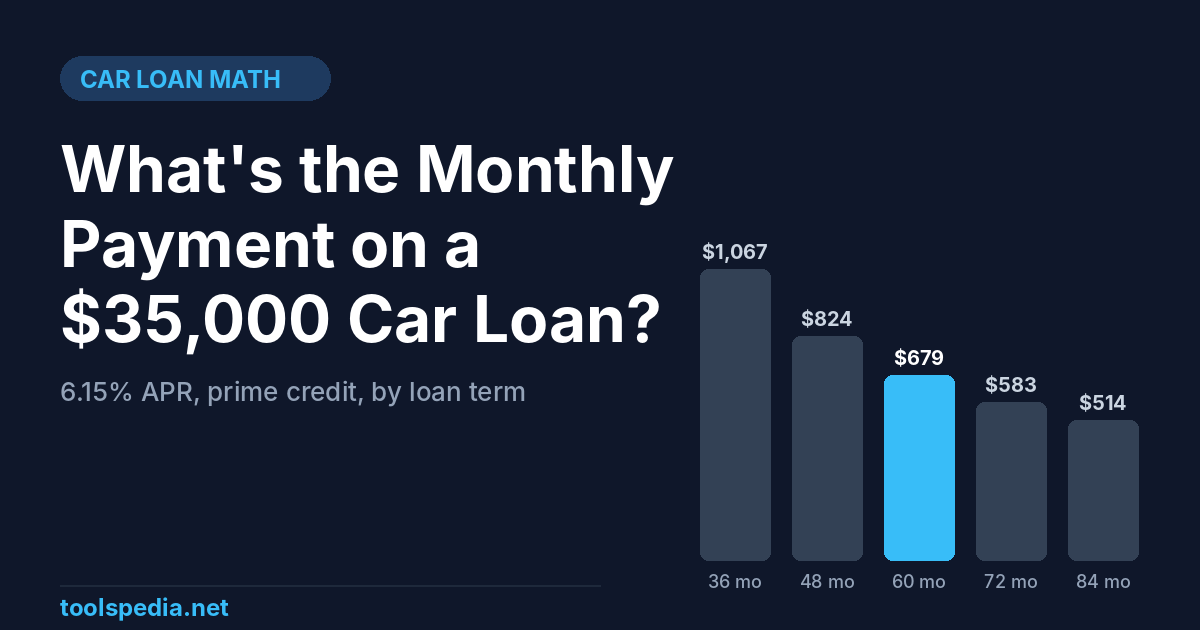
On a $35,000 car loan at 6.15% APR for 60 months, the monthly payment is $679.09, and you pay $5,745.52 in interest over the life of the loan. That 6.15% is not a random number: it is Experian's average new-car APR for borrowers with prime credit (VantageScore 661-780) in Q2 2026. Change the credit score or the term and the payment swings by more than $300 a month, so the useful answer is a table, not a single figure.
Below are the exact payments for every common term and credit tier, a worked example you can reproduce in our loan calculator, and the mistakes that make a "$35,000 car" cost far more than $35,000.
The formula behind every car payment
Almost every US auto loan is a fixed-rate, fully amortizing loan. The monthly payment is:
M = P x r / (1 - (1 + r)^-n)
- P = the amount you borrow (price + taxes + fees - down payment - trade-in)
- r = APR divided by 12, as a decimal (6.15% / 12 = 0.005125)
- n = number of monthly payments (60 for a five-year loan)
Plugging in $35,000, 0.005125 and 60 gives $679.09. Early payments are mostly interest; by the last year almost all of each payment goes to principal. On this loan you pay $1,980.55 of interest in the first 12 months and only $265.10 in the fifth year.
$35,000 car loan payments by loan term
All figures use the same 6.15% prime APR so you can see the effect of the term alone:
| Term | Monthly payment | Total interest | Total paid |
|---|---|---|---|
| 36 months (3 years) | $1,067.15 | $3,417.34 | $38,417.34 |
| 48 months (4 years) | $824.39 | $4,570.49 | $39,570.49 |
| 60 months (5 years) | $679.09 | $5,745.52 | $40,745.52 |
| 72 months (6 years) | $582.53 | $6,942.34 | $41,942.34 |
| 84 months (7 years) | $513.82 | $8,160.88 | $43,160.88 |
Stretching from 60 to 84 months lowers the payment by $165.27 a month but adds $2,415.36 of interest. And this table assumes the rate stays the same; in practice lenders usually charge a higher APR on longer terms, so the real gap tends to be wider.
A quick shortcut: at 6.15%, every $1,000 borrowed costs about $30.49 a month over 36 months, $23.55 over 48, $19.40 over 60, $16.64 over 72 and $14.68 over 84. Multiply by the thousands you plan to finance for a fast estimate on the dealer lot.
How your credit score changes the payment
Experian's Q2 2026 data shows average APRs by credit tier. Here is what those rates mean for a $35,000, 60-month loan:
| Credit tier (VantageScore) | New car APR | Payment | Total interest | Used car APR | Payment | Total interest |
|---|---|---|---|---|---|---|
| Super prime (781-850) | 4.41% | $651.07 | $4,064.46 | 6.29% | $681.38 | $5,882.66 |
| Prime (661-780) | 6.15% | $679.09 | $5,745.52 | 8.81% | $723.32 | $8,399.15 |
| Near prime (601-660) | 9.71% | $738.66 | $9,319.73 | 13.93% | $813.12 | $13,787.15 |
| Subprime (501-600) | 13.52% | $805.71 | $13,342.32 | 19.10% | $909.85 | $19,590.77 |
| Deep subprime (300-500) | 16.11% | $853.18 | $16,190.74 | 21.62% | $959.12 | $22,546.91 |
Rates source: Experian, average car loan interest rates by credit score (Q2 2026). Payments calculated by Toolspedia.
The same $35,000 costs a super-prime borrower $4,064 in interest and a deep-subprime borrower $16,191, a difference of $12,126 for the exact same car. If your score sits just below a tier boundary, a few months of paying down card balances before you shop can be worth more than any amount of haggling on price.
Worked example: from window sticker to monthly payment
Most people do not actually borrow the sticker price. Say you are buying a compact SUV in the US with these numbers:
- Out-the-door price (vehicle, sales tax, title, registration and doc fee): $37,000
- Cash down payment: $2,000
- Amount financed: $35,000
- Pre-approved rate from your credit union: 6.15% APR for 5 years
To check it in the Toolspedia loan calculator:
- Enter 37000 in Loan Amount.
- Enter 6.15 in Annual Interest Rate.
- Enter 5 in Loan Term (Years).
- Enter 2000 in Down Payment. The calculator subtracts it from the amount, so it finances $35,000.
The result should read $679.09 a month, with a year-by-year amortization table showing the balance falling from $35,000 to zero. Two things to watch: the Down Payment box has a default value, so set it to 0 if you are entering the amount already financed, and the term box takes whole years, so a 66-month or 75-month offer has to be checked with the formula above.
Now compare the dealer's offer. If the finance office pitches "only $583 a month," that is very likely the same $35,000 stretched to 72 months. It looks $96.56 cheaper per month but costs $1,196.82 more in total interest, and after two years you would still owe $24,731.93 instead of $22,272.65. That $2,459 gap matters if you want to trade the car in early, because a used SUV can easily be worth less than a 72-month balance.
Is $679 a month affordable?
There is no official rule, but a widely used guideline is the 20/4/10 rule: put 20% down, finance for no more than 4 years, and keep total car costs (payment, insurance, fuel) under 10% of gross monthly income. A $679.09 payment by itself would take 10% of a $6,790.92 monthly income, about $81,491 a year, before insurance and gas are even counted.
Following the rule fully on a $37,000 car means $7,400 down, $29,600 financed over 48 months at 6.15%: $697.19 a month and $3,865.33 of interest. The payment is about the same as the 60-month loan, but you pay $1,880.19 less interest and owe less than the car is worth much sooner.
For context, Experian reports the average new-car loan in Q2 2026 was $43,610 over about 69.5 months, with an average new-car payment of $765. A $35,000 loan on a 60-month term is below average, which is a reasonable place to be.
Do not forget running costs. If the car will cover long distances, our guide to how much it costs to drive 500 miles shows how to budget fuel, and if you are also planning a home purchase, the car payment counts against you in how much house you can afford, because lenders include it in your debt-to-income ratio.
Paying a little extra each month
Most US auto loans calculate interest on the outstanding balance, so extra principal payments cut interest directly (check that your contract has no prepayment penalty and tell the lender to apply extra money to principal, not to next month's payment).
On the 72-month, 6.15% loan of $35,000:
- Adding $50 a month pays it off in 66 months and saves $676.77 in interest.
- Adding $100 a month pays it off in 60 months and saves $1,231.37 in interest.
In other words, taking the 72-month loan and paying $682.53 a month gets you almost the same result as the 60-month loan ($5,710.97 vs $5,745.52 of interest), while keeping the option to drop back to the lower payment in a tight month. The catch is discipline, and the longer loan may carry a higher rate to begin with.
The US car loan interest deduction
For tax years 2025 through 2028, the IRS allows a deduction of up to $10,000 a year for interest on a loan for a qualifying vehicle, whether or not you itemize. According to the IRS, the loan must be originated after December 31, 2024 and secured by the vehicle, the vehicle must be new (used vehicles do not qualify), for personal use, under 14,000 pounds gross vehicle weight rating, and have had its final assembly in the United States. Leases do not qualify, and the deduction phases out above $100,000 of modified AGI ($200,000 for joint filers).
If our example SUV qualifies, the first 12 months of interest is $1,980.55. For a filer in the 22% bracket, that deduction is worth about $435.72 in federal tax. It is a real saving, but it does not change the monthly payment, and it shrinks each year as the interest portion falls. Check the vehicle's assembly plant on the window label or VIN before counting on it, and talk to a tax professional about your situation.
Outside the US: UK, Canada and Australia
The amortization math is identical everywhere, but the way loans are quoted differs:
- Canada: dealers often quote biweekly payments. A $35,000 loan at 6.15% over 5 years works out to $313.06 every two weeks (130 payments), with $5,697.66 of total interest, slightly less than monthly because the balance falls more often.
- UK: many new cars are sold on PCP, where a large "optional final payment" is deferred to the end. A standard calculator does not model that balloon, so it will overstate a PCP monthly payment; it works for hire purchase and personal loans.
- Australia: lenders advertise a comparison rate that folds in most fees. Use that figure rather than the headline rate when you run the numbers.
Our calculator labels amounts in dollars, but the math does not care about currency: enter 35000 for pounds or Canadian dollars and the result is in the same currency.
Calculator, spreadsheet or dealer quote?
A dealer's finance office will happily run payments for you, but it often leads with the monthly figure and starts from the payment you say you can afford, which makes it easy to slide into a longer term. A spreadsheet works too: in Excel or Google Sheets, =PMT(6.15%/12,60,-35000) returns 679.09. The advantage of an online car loan payment calculator is speed on your phone and a full amortization table without building one. Whichever you use, compare offers on three numbers at once: monthly payment, term and total interest. A lower payment with a higher total is not a better deal.