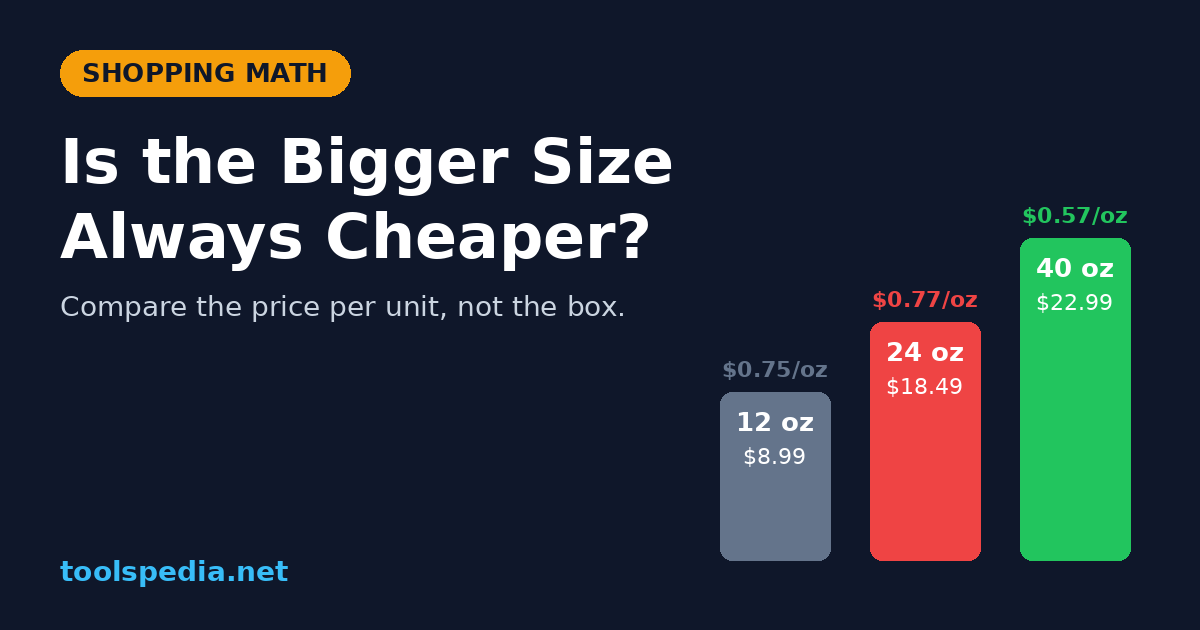
No. The bigger package is usually cheaper per ounce, but not always, and the exceptions are common enough that assuming it costs real money. In our coffee example below, the 24 oz bag costs more per ounce than the 12 oz bag sitting next to it, while the 40 oz canister is 23.3% cheaper per ounce than the small bag. The only way to know is to compare the price per unit, and to make sure you are comparing the same unit.
This guide walks through the math with real numbers, the label traps that catch shoppers in US, UK, Canadian and Australian stores, and the cases where the "cheaper" size still is not the better buy.
The formula: price divided by quantity
Unit price is simply:
unit price = total price / quantity
A $8.99 bag of coffee that holds 12 oz costs 8.99 / 12 = $0.7492 per ounce. Multiply by 16 and you get the price per pound: $11.99/lb. If you think in metric, 12 oz is about 340 g, so the same bag is $2.64 per 100 g.
The formula is trivial. The mistakes happen in the inputs: mixing ounces with pounds, comparing per roll instead of per sheet, or forgetting that a "2 for $7" sale changes the price of the small size.
Worked example: three sizes of the same coffee
Here is a realistic shelf of one brand of ground coffee (example prices):
| Size | Price | Per ounce | Per pound | Per 100 g |
|---|---|---|---|---|
| 12 oz bag (340 g) | $8.99 | $0.7492 | $11.99 | $2.64 |
| 24 oz bag (680 g) | $18.49 | $0.7704 | $12.33 | $2.72 |
| 40 oz canister (1,134 g) | $22.99 | $0.5748 | $9.20 | $2.03 |
Three things stand out:
- The middle size is the worst deal. The 24 oz bag is exactly double the 12 oz bag, but it costs $0.51 more than two small bags ($18.49 vs $17.98). Per ounce it is 2.8% more expensive than the small bag.
- The largest size really is cheapest. At $0.5748/oz the canister is 23.3% cheaper per ounce than the 12 oz bag. Buying 40 oz as small bags would cost 40 x $0.7492 = $29.97, so the canister saves $6.98.
- Price jumps are not proportional. Stores and brands set each size's price separately, often to hit a price point like $18.49, so the per-ounce price can go up, down or sideways as the package grows.
To check this yourself, enter each size into the Unit Price Comparator with the price, the quantity and the unit (here, 12, 24 and 40 ounces). It ranks the items by unit price and shows how much more each one costs than the best deal. For this shelf it reports the canister as the best deal, the 12 oz bag as +30.3% more and the 24 oz bag as +34.0% more.
Trap 1: the labels use different units
Many shelf tags already show a unit price, but they do not always use the same unit for every product in an aisle. One tray of chicken breast might be tagged per pound while the tray next to it is tagged per ounce:
- Tray A: 1.5 lb for $6.49, tag says $4.33/lb
- Tray B: 20 oz for $4.79, tag says $0.24/oz
At a glance $0.24 looks far cheaper than $4.33, but those numbers are not comparable. Convert Tray B to pounds: $0.2395 x 16 = $3.83/lb. Tray B is still cheaper, by $0.49 per pound, but the label alone could just as easily have hidden the opposite result.
This is a known problem. The US National Institute of Standards and Technology's unit pricing guide (NIST SP 1181) recommends that the units used "should be consistent across each product category" and notes that inconsistent units make it difficult for consumers to compare value.
Important when using a calculator: our comparator divides price by whatever quantity you type, so every item in one comparison must use the same unit. Enter 24 oz and 20 oz, not 1.5 lb and 20 oz. If a package lists only grams or only pounds, convert it first with the weight converter (1 lb = 16 oz = 453.6 g; 1 oz = 28.35 g).
Trap 2: "count" is not the real unit
Toilet paper, paper towels, trash bags and diapers are sold by count, and the count is often the wrong thing to compare. "Mega" and "double" rolls are not a standard size, so compare the price per 100 sheets (or per square foot, if the pack lists area):
| Pack | Price | Per roll | Total sheets | Per 100 sheets |
|---|---|---|---|---|
| 12 double rolls, 230 sheets each | $9.49 | $0.791 | 2,760 | $0.344 |
| 6 mega rolls, 400 sheets each | $8.99 | $1.498 | 2,400 | $0.375 |
The 6-roll pack is cheaper at the register and has bigger rolls, but you get 360 fewer sheets and pay about 9% more per sheet. In the comparator, choose "Pieces" and enter the total sheet count (2,760 and 2,400) instead of the number of rolls. Check that sheet sizes are similar too; a brand that trims its sheets narrower can match the count while giving you less paper.
Trap 3: sales and coupons flip the answer
Unit price tags are usually calculated on the regular shelf price. A promotion on the smaller size can easily beat the bulk size. Take a cereal sold in two sizes:
- 18 oz box, $4.29: $0.2383/oz
- 27 oz "family size", $7.29: $0.2700/oz (13.3% more per ounce than the small box even at regular price)
- 18 oz box on a "2 for $7" deal: $3.50 each, $0.1944/oz
With the sale, the family size costs 38.9% more per ounce than the regular box. Always recalculate using the price you will actually pay. If several discounts stack, work out the final price first; our post on whether 20% off plus an extra 15% off equals 35% off shows why you multiply discounts instead of adding them, and the discount calculator does it in one step.
When the cheaper unit price is still the wrong buy
You will not use it all
Food you throw away still counts. A 5 oz clamshell of baby spinach at $2.99 costs $0.598/oz. A 16 oz tub at $5.99 costs only $0.374/oz, but if a household realistically eats 60% of it before it wilts (9.6 oz), the cost per ounce actually eaten is $5.99 / 9.6 = $0.624. The "bulk" tub is now the more expensive option. The Connecticut Department of Consumer Protection makes the same point: a smaller container can be the better choice if you will not use the larger one before it expires.
A quick rule: divide the price by the amount you will use, not the amount in the package.
The trip costs more than the savings
If the big size is only sold at a warehouse club or a store farther away, add the cost of getting there. An extra 18-mile round trip in a car that gets 28 mpg, with gas at $3.10 a gallon, costs 18 / 28 x 3.10 = $1.99 in fuel alone. If your savings on the trip are under $2, you have not saved anything. We break down that fuel math in how much it costs to drive 500 miles. Membership fees work the same way: divide the annual fee by your expected yearly savings to see whether the card pays for itself.
Cash flow and storage
Paying $22.99 instead of $8.99 ties up money and shelf space. That is not a math error, but it is a real cost for people living in small apartments or on a tight weekly budget. Bulk also makes the most sense for products that keep: rice, canned goods, detergent, paper goods. It makes the least sense for fresh produce, bread and anything you are trying for the first time.
What the law requires on shelf labels
Rules on unit pricing differ by country, so do not assume every store must show it:
- United States: there is no federal requirement. According to NIST SP 1181, unit pricing is voluntary unless a state requires it, and 16 states have unit pricing laws or regulations (including Connecticut, Massachusetts, New Jersey, New York and Oregon). Elsewhere, many grocers show it voluntarily, and the unit they choose may vary.
- United Kingdom: under the Price Marking Order 2004, most retailers must show a unit price per kilogram, per litre or per item, as applicable. The government guidance also lists exemptions, including small shops with a floor area of no more than 280 square metres for most pre-packed goods. Amendments that took effect on 6 April 2026 added rules for loyalty and multibuy prices.
- Canada and Australia: rules and store practice vary, so check the tag for its unit and do the math yourself when it is missing or inconsistent.
Ways to compare, honestly ranked
| Method | Good for | Weak spot |
|---|---|---|
| Shelf unit price tag | Fast in-store checks | Units can differ; usually ignores sale prices; not required everywhere |
| Phone calculator | One quick division | Easy to mix units; no ranking for 3 or more items |
| Spreadsheet (Excel, Google Sheets) | Tracking prices over weeks | Setup time; overkill in an aisle |
| Unit Price Comparator | Ranking several sizes or stores at once with percent differences | You must enter all items in the same unit |
A 30-second checklist in the store
- Read the net quantity on each package, not the size of the box.
- Put everything in one unit (ounces, grams, sheets, loads).
- Use the price you will pay today, including sales, multibuys and coupons.
- Divide price by quantity, or by the quantity you will actually use for perishables.
- Compare. If the difference is a few cents, buy the size that fits your storage and budget.
Bigger is cheaper often enough to feel like a rule, which is exactly why the exceptions work. A few seconds of division tells you which package is really the better deal.