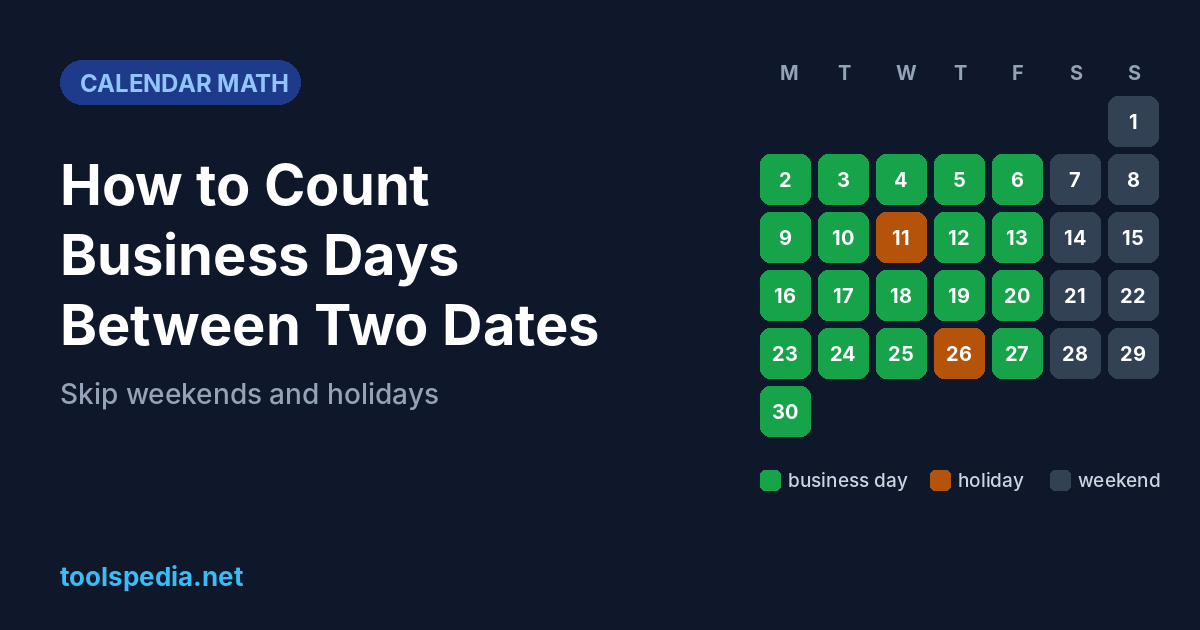
"Delivery in 5-7 business days." "Please respond within 10 business days." "Your refund will be processed in 3 to 5 working days." These phrases appear on almost every order, contract and government letter, and they are easy to get wrong. A business day is normally Monday to Friday, excluding public holidays, so a promise made on a Friday before Thanksgiving can land much later than you expect.
This guide shows how to count business days between two dates, how to add business days to a date to find a deadline, and how to handle holidays, with every example worked out day by day.
What counts as a business day
In the US, UK, Canada and Australia, a business day (also called a working day) usually means:
- Monday through Friday
- not a public or bank holiday
Saturdays and Sundays never count. Holidays are where it gets messy, because each organization decides which ones it observes. US federal agencies, banks and the US Postal Service follow the federal holiday calendar, while many private companies close only on a few of those days. When a contract or a company says "business days", check which holiday calendar it uses.
Step 1: Count the weekdays
The fastest way to count weekdays is the Date Difference Calculator:
- Pick the Start Date and the End Date.
- Click Calculate Difference.
- Read the Workdays figure. It counts every Monday to Friday from the start date to the end date, including both of them.
The same result also shows the gap in years, months and days, the total number of days, weeks, hours and minutes, which is handy when you need to quote the period in a different way.
Worked example: from November 3 to Christmas Eve
Say today is Tuesday, November 3, 2026, and you want to know how many working days are left before Thursday, December 24, 2026:
- Total days between the dates: 51 (7 full weeks and 2 days)
- Weekdays from November 3 to December 24, counting both dates: 38
If you do not want to count today because the day is already half over, subtract one: 37 weekdays.
Step 2: Subtract the holidays
A weekday count ignores holidays, so take them off yourself. Only subtract holidays that fall on a weekday inside your date range. These are the US federal holidays published by the Office of Personnel Management for 2026 and 2027:
| Holiday | 2026 | 2027 |
|---|---|---|
| New Year's Day | Thu, Jan 1 | Fri, Jan 1 |
| Martin Luther King Jr. Day | Mon, Jan 19 | Mon, Jan 18 |
| Washington's Birthday | Mon, Feb 16 | Mon, Feb 15 |
| Memorial Day | Mon, May 25 | Mon, May 31 |
| Juneteenth | Fri, Jun 19 | Fri, Jun 18 (observed) |
| Independence Day | Fri, Jul 3 (observed) | Mon, Jul 5 (observed) |
| Labor Day | Mon, Sep 7 | Mon, Sep 6 |
| Columbus Day | Mon, Oct 12 | Mon, Oct 11 |
| Veterans Day | Wed, Nov 11 | Thu, Nov 11 |
| Thanksgiving Day | Thu, Nov 26 | Thu, Nov 25 |
| Christmas Day | Fri, Dec 25 | Fri, Dec 24 (observed) |
"Observed" means the holiday falls on a weekend, so the nearest weekday is taken off instead: a Saturday holiday moves to the Friday before, and a Sunday holiday moves to the Monday after.
Back to the example: between November 3 and December 24, 2026, two federal holidays fall on weekdays, Veterans Day (November 11) and Thanksgiving (November 26). So:
38 weekdays - 2 holidays = 36 business days under the federal calendar. If your office stays open on Veterans Day, as many private employers do, the answer is 37.
Adding business days to find a deadline
The other common question goes the other way: what date is "10 business days from today"? The usual convention is that the day of the event does not count, and you start counting from the next business day.
Example 1: "Ships in 5-7 business days"
You order on Friday, November 20, 2026. Counting from Monday, November 23, and skipping Thanksgiving:
- Mon, Nov 23
- Tue, Nov 24
- Wed, Nov 25
- Fri, Nov 27 (Thursday the 26th is Thanksgiving)
- Mon, Nov 30
So 5 business days lands on Monday, November 30, and 7 business days lands on Wednesday, December 2. Without the holiday, 5 business days would have been Friday, November 27, which is why holiday-week orders so often seem late.
Example 2: "Respond within 10 business days"
A letter dated Monday, December 14, 2026 asks for a reply within 10 business days. Counting from December 15 and skipping Christmas Day (Friday, December 25), the deadline is Tuesday, December 29. Ignore the holiday and you would think it was Monday, December 28.
How many working days are in a year?
Both 2026 and 2027 have 261 weekdays. All 11 federal holidays in each year fall on a weekday (counting the observed dates), so a full-time employee on the federal calendar has 250 working days in each year, before any vacation or sick days. At 8 hours a day that is 2,000 working hours. The common 2,080-hour figure is simply 52 weeks x 40 hours, before holidays are taken off.
If you are turning an annual salary into an hourly rate, our guide to how much $60,000 a year is per hour walks through that math.
Doing it in Excel or Google Sheets
If you count business days often, a spreadsheet does it in one formula. Excel and Google Sheets both have:
=NETWORKDAYS(start, end, holidays)- counts Monday to Friday between two dates, including both dates, and subtracts any dates listed in the holidays range.=WORKDAY(start, days, holidays)- adds a number of business days to a start date and returns the deadline.=NETWORKDAYS.INTLand=WORKDAY.INTL- the same, but you choose which days count as the weekend, for example a Friday-Saturday weekend.
With November 3, 2026 in A1, December 24, 2026 in B1, and Veterans Day and Thanksgiving in H1:H2, =NETWORKDAYS(A1,B1,H1:H2) returns 36. With November 20, 2026 in A2, =WORKDAY(A2,5,H1:H2) returns November 30, 2026.
Common mistakes
- Counting the start day. Calculators and NETWORKDAYS include both dates. For a deadline, most businesses start counting the next day. Decide which you need before you trust a number.
- Using the wrong holiday list. Banks and federal offices close on all federal holidays; many retailers and private companies do not. UK, Canadian and Australian holidays are different again, and some vary by state, province or nation.
- Forgetting observed dates. When a holiday falls on a weekend, the day off moves to Friday or Monday, which changes your count.
- Cut-off times. An order placed at 9 p.m. is often treated as placed the next business day.
- Time zones. "Business day" usually means the business's local time zone, not yours.
For quick checks, the Date Difference Calculator gives you the weekday count in seconds; subtract the holidays that apply to you, and you have your answer. To total the hours inside those days instead, try the Time Duration Calculator, and see our guide to converting minutes to decimal hours for timesheets.